The Question #
For a century and a half, astronomers calibrated the brightness and color zero point of the entire sky ($V \approx +0.03$, $B - V = 0.00$) on Vega ($\alpha$ Lyrae), treating it as a calm, spherical A0V reference star. Then high-resolution spectroscopy (Gulliver, Hill & Adelman 1994) and optical/IR interferometry (Peterson et al. 2006; Aufdenberg et al. 2006; resolved with six-beam CHARA/MIRC by Monnier et al. 2012, ApJL 761:L3) showed that Vega is actually a rapidly rotating oblate star viewed almost straight down its rotation axis ($i = 6.2^\circ \pm 0.4^\circ$, $\Omega/\Omega_c = 0.774 \pm 0.012$, $R_e/R_p = 1.127$ — slightly more flattened than Saturn's $f = 0.098$ at $f = 0.113$).
I wanted to build the physics from scratch — Roche equipotential geometry, classical von Zeipel (1924) vs. Espinosa Lara & Rieutord (2011, A&A 533:A43) gravity darkening, and a wavelength-dependent Milne–Eddington gray radiative-transfer atmosphere — and answer four concrete questions:
- Does Espinosa Lara & Rieutord's zero-free-parameter analytic PDE really predict Monnier et al.'s (2012) measured gravity-darkening exponent $\beta$?
- How much brighter does Earth see Vega than an equatorial observer at the exact same 7.68 pc distance — and how does that brightening break down into geometry, gravity darkening, and limb darkening?
- How could optical spectrophotometry miss Vega's rapid rotation for 150 years — and what hidden signature does it leave in the UV and K-band ($2.19\,\mu\text{m}$)?
- How do weak absorption lines on the exact same star split into flat-bottomed boxes vs. sharp needles?
Along the way, the numbers handed me three genuine surprises I didn't expect going in.
1. Roche Geometry & Espinosa Lara–Rieutord (2011) Gravity Darkening #
In the Roche approximation (point-mass gravity plus solid-body centrifugal potential), the dimensionless surface radius $\tilde{r}(\theta) = r(\theta)/R_e$ satisfies the cubic
At the pole ($\theta = 0$), $\tilde{r}_p = R_p/R_e = \frac{2}{2+\omega^2}$, hitting the exact critical cusp $R_e/R_p = 3/2$ at $\omega = 1$. The angular-velocity fraction relative to breakup at fixed $R_p$ is
Plugging Monnier et al.'s (2012) Concordance $\Omega/\Omega_c = 0.774$ gives $\omega = 0.5041$, $R_e/R_p = 1.1271$, and $v_e/v_c = 0.5816$ — matching Monnier's fitted $R_e/R_p = 2.726/2.418 = 1.1274$ and $v/v_c = 0.581$ to $0.1\%$.
Why von Zeipel ($\beta = 1/4$) fails and what ELR (2011) fixes #
Classical von Zeipel (1924) assumes $\mathbf{F} = -f \mathbf{g}_{\text{eff}}$ with constant $f$ on an equipotential, giving $T_{\text{eff}} \propto g_{\text{eff}}^{1/4}$. That violates energy conservation outside the core because $\nabla \cdot \mathbf{g}_{\text{eff}} = 2\Omega^2 \ne 0$ (von Zeipel's paradox). Espinosa Lara & Rieutord (2011) let $f(r, \theta)$ vary while enforcing $\nabla \cdot \mathbf{F} = 0$, solving the resulting first-order PDE by the method of characteristics along effective-gravity streamlines:
At the equator vs. pole, this gives a closed-form temperature ratio where the breakup exponent on $(1 - \omega^2)$ drops from von Zeipel's $1/4$ to $1/12$:
| $\Omega/\Omega_c$ | $\omega$ | $R_e/R_p$ | $v/v_c$ | $T_{\text{eq}}/T_{\text{pole}}$ (vZ) | $T_{\text{eq}}/T_{\text{pole}}$ (ELR) | Effective $\beta_{\text{eff}}$ (ELR) |
|---|---|---|---|---|---|---|
| 0.010 | 0.0054 | 1.0000 | 0.0067 | 0.99999 | 0.99999 | 0.2500 |
| 0.500 | 0.2894 | 1.0419 | 0.3473 | 0.95849 | 0.96064 | 0.2368 |
| 0.774 (Monnier 2012) | 0.5041 | 1.1271 | 0.5816 | 0.87537 | 0.89241 | 0.2138 |
| 0.860 (Monnier M2) | 0.6001 | 1.1801 | 0.6766 | 0.82334 | 0.85513 | 0.2013 |
| 0.916 (Aufdenberg 2006) | 0.6827 | 1.2330 | 0.7530 | 0.76982 | 0.81999 | 0.1897 |
| 0.990 (near breakup) | 0.8828 | 1.3897 | 0.9172 | 0.58136 | 0.71256 | 0.1562 |
Result 1: With zero free parameters, ELR (2011) predicts $\beta_{\text{eff}} = \mathbf{0.214}$ at Vega's exact rotation ($\Omega/\Omega_c = 0.774$), sitting squarely inside Monnier et al.'s (2012) interferometric fit $\beta = 0.231 \pm 0.028$ (and yielding $T_{\text{eq}} = 8984\text{ K}$ for $T_{\text{pole}} = 10070\text{ K}$, vs. Monnier's $8910 \pm 130\text{ K}$).
2. Exact Axisymmetric Integration, Conservation Check, and the Funk–Hecke Quadrupole Lock #
Because the Roche surface is axisymmetric, $T(\theta)$ is constant around each latitude ring. With $\mu(\theta,\phi) = \hat{\mathbf{n}}\cdot\hat{\mathbf{o}} = A + B\cos\phi$ ($A = n_z\cos i$, $B = n_\rho\sin i \ge 0$), the azimuthal visibility moments $M_1 = \int_{\mu>0}\mu\,d\phi$ and $M_2 = \int_{\mu>0}\mu^2\,d\phi$ have exact closed forms in $\phi_0 = \arccos(-A/B)$, eliminating azimuthal discretization error.
Sanity check (4π flux conservation): Integrating our Vega model over all viewing angles $\int_0^{\pi/2} L_{\text{app}}(i)\sin i\,di$ reproduces the true bolometric luminosity $L_{\text{bol}}$ to $3.8 \times 10^{-6}$ (pure midpoint quadrature residual in $i$). For Monnier's Concordance inputs ($R_e = 2.726\,R_\odot$, $T_{\text{pole}} = 10070\text{ K}$, $\Omega/\Omega_c = 0.774$):
- Model 3 ($\beta = 0.231$, $u = 0.6$): $L_{\text{bol}} = 47.21\,L_\odot$ (Monnier: $47.2 \pm 2.0\,L_\odot$), $T_{\text{surf,avg}} = 9357\text{ K}$ (Monnier: $9360 \pm 90\text{ K}$), $L_{\text{app}}(6.2^\circ) = 57.70\,L_\odot$ (Monnier: $58.4 \pm 2.2\,L_\odot$).
- ELR 2011 ($\omega = 0.5041$, $u = 0.6$): $L_{\text{bol}} = 48.15\,L_\odot$, $L_{\text{app}}(6.2^\circ) = 58.42\,L_\odot$ (+21.3% brighter than true $L_{\text{bol}}$), $L_{\text{app}}(90^\circ) = 42.91\,L_\odot$ (−10.9% dimmer than true $L_{\text{bol}}$).
3-Way Decomposition of Pole-to-Equator Brightening #
| Model Variant | $L(0^\circ)/L_{\text{bol}}$ | $L(90^\circ)/L_{\text{bol}}$ | $\Delta m_{\text{bol}}(90^\circ - 0^\circ)$ | Honest angle $i^*$ | $i^* - 54.736^\circ$ |
|---|---|---|---|---|---|
| Vega: Geometry only ($T=\text{const}, u=0$) | 1.0872 | 0.9587 | +0.1365 mag | 54.206° | −0.530° |
| Vega: Geometry + LD ($T=\text{const}, u=0.6$) | 1.1113 | 0.9455 | +0.1755 mag | 54.533° | −0.202° |
| Vega: Geometry + ELR ($u=0$) | 1.1665 | 0.9162 | +0.2623 mag | 54.771° | +0.036° |
| Vega: Geometry + ELR + LD ($u=0.6$) | 1.2172 | 0.8911 | +0.3385 mag | 54.749° | +0.014° |
| Aufdenberg 2006 ($\Omega/\Omega_c=0.916$, ELR+LD) | 1.3885 | 0.8058 | +0.5908 mag | 54.700° | −0.036° |
| Near-breakup ($\Omega/\Omega_c=0.990$, ELR+LD) | 1.6092 | 0.6990 | +0.9053 mag | 54.530° | −0.206° |
Three things pop out immediately:
- The pole-on brightening splits cleanly three ways (out of $+0.3385\text{ mag}$ total): 40.3% from pure oblate geometry (larger projected cross-section pole-on), 37.2% from gravity darkening (hot pole faces us), and 22.5% from limb-darkening spotlighting (limb darkening suppresses the cool equatorial rim at $i=0^\circ$ while letting the hot pole shine at $\mu = 1$, and reverses at $i=90^\circ$).
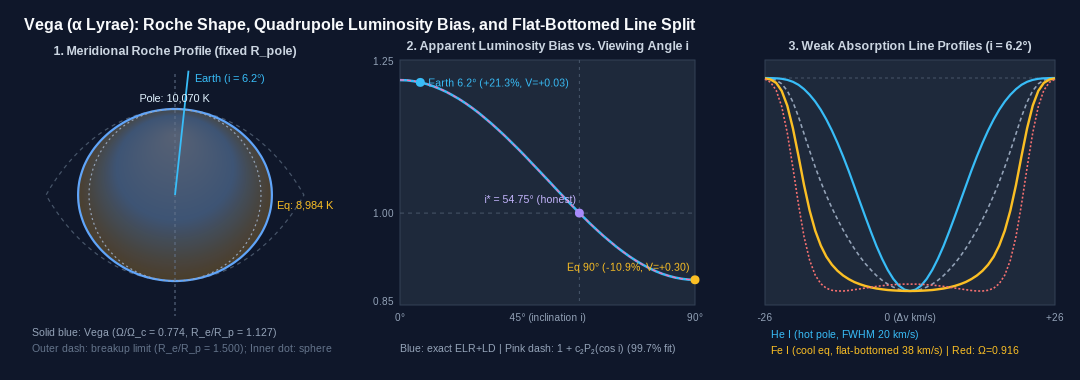
- Surprise #1 — The Funk–Hecke Quadrupole Lock: Why is the "honest angle" $i^*$ where $L_{\text{app}}(i^*) = L_{\text{bol}}$ locked to $\arccos(1/\sqrt{3}) = 54.7356^\circ$ within $0.014^\circ$ (50 arcseconds!) for Vega — and still within $0.21^\circ$ even at 99% of breakup? Expanding $L_{\text{app}}(\cos i)/L_{\text{bol}} = 1 + c_2 P_2(\cos i) + c_4 P_4(\cos i) + \dots$ gives:
- Geometry only ($u=0$): $c_2 = +0.08464$, $c_4 = +0.002404$ ($|c_4/c_2| = 2.84\%$).
- Geometry + ELR ($u=0$): $c_2 = +0.16735$, $c_4 = -0.000880$ ($|c_4/c_2| = 0.53\%$) — the gravity-darkening $\ell=4$ component has opposite sign to the geometric $\ell=4$ component and nearly cancels it!
- Add Eddington limb darkening ($u=0.6$): $c_2 = +0.21757$, $c_4 = -0.000615$ ($|c_4/c_2| = 0.28\%$)! Why did limb darkening suppress $c_4$? Because the linear limb-darkening visibility kernel contains $\max(0,\mu)\cdot\mu = \max(0,\mu^2)$, and $\mu^2 = \frac{1}{3}P_0(\mu) + \frac{2}{3}P_2(\mu)$ is strictly orthogonal to $P_4, P_6, \dots$ on $[0, 1]$! In Funk–Hecke spherical convolution, the $u\mu$ term amplifies only $\ell = 0$ and $\ell = 2$ while adding identically zero $\ell \ge 4$ power!
- Consequence: $L_{\text{app}}(i)/L_{\text{bol}}$ is 99.7% pure quadrupole, locking $i^* \approx 54.74^\circ$ and locking the pole-brightening excess to exactly twice the equatorial dimming deficit ($+21.7\%$ vs. $-10.9\%$, ratio $1.994$; $+60.9\%$ vs. $-30.1\%$ at 99% breakup, ratio $2.024$).
3. What Would Vega Look Like From Its Own Equator? #
Using the Milne–Eddington gray-atmosphere temperature profile $T^4(\tau) = \frac{3}{4}T_{\text{eff}}^4(\tau + \frac{2}{3})$, the emergent specific intensity at wavelength $\lambda$ is
which produces physically realistic wavelength-dependent limb darkening with zero free parameters: $u_{250\text{nm}} \approx 0.82$ (steep UV Wien-tail), $u_V \approx 0.41$, $u_K \approx 0.20$ (flat IR Rayleigh–Jeans), while integrating over all $\lambda$ to exact Eddington $u_{\text{bol}} = 0.60$.
Zero-pointing at Earth's view ($i = 6.2^\circ$, $V = +0.030$, colors $= 0.000$):
| Viewing angle $i$ | $V$ mag | $\Delta\text{UV}_{250}$ | $\Delta U$ | $\Delta B$ | $\Delta V$ | $\Delta K$ | $B - V$ | $V - K$ |
|---|---|---|---|---|---|---|---|---|
| 0.0° (pole) | +0.027 | −0.004 | −0.003 | −0.003 | −0.003 | −0.002 | −0.000 | −0.001 |
| 6.2° (Earth) | +0.030 | 0.000 | 0.000 | 0.000 | 0.000 | 0.000 | 0.000 | 0.000 |
| 30.0° | +0.089 | +0.089 | +0.071 | +0.064 | +0.059 | +0.045 | +0.005 | +0.014 |
| 54.7° (honest $i^*$) | +0.199 | +0.268 | +0.208 | +0.187 | +0.169 | +0.126 | +0.017 | +0.043 |
| 75.0° | +0.276 | +0.402 | +0.307 | +0.273 | +0.246 | +0.180 | +0.027 | +0.067 |
| 90.0° (equator) | +0.297 | +0.439 | +0.333 | +0.296 | +0.267 | +0.194 | +0.030 | +0.073 |
An observer at 7.68 pc in Vega's equatorial plane sees the exact same star as $V = +0.30$ (+0.27 mag dimmer — dropping below Capella and Rigel down near Procyon), +0.44 mag dimmer in the UV, and redder by $\Delta(B-V) = +0.030$, $\Delta(V-K) = +0.073$. At 99% breakup ($\Omega/\Omega_c = 0.99$), the same viewing-angle swing reaches +0.76 mag in $V$ and +1.20 mag (3×) in the UV.
4. The 150-Year Spectrophotometric Mirage & Depth–Latitude Interference #
Fit the single best non-rotating spherical star $(T_{\text{fit}}, R_{\text{fit}})$ to Vega's optical spectrum ($380\text{–}750\text{ nm}$), then inspect residuals from $200\text{ nm}$ (UV) to $10\,\mu\text{m}$ (mid-IR):
| Inclination $i$ | Atmosphere | Best optical $T_{\text{fit}}$ | 200 nm (UV) | 551 nm ($V$) | 2190 nm ($K$) | $10\,\mu\text{m}$ |
|---|---|---|---|---|---|---|
| 6.2° (Earth) | Pure Planck (no LD) | 9574 K | +1.02% | −0.02% | +0.15% | +0.21% |
| 6.2° (Earth) | Milne–Eddington Gray | 9687 K | +3.14% | −0.05% | +0.54% | +0.76% |
| 54.74° (magic) | Pure Planck (no LD) | 9413 K | +1.35% | −0.02% | +0.19% | +0.27% |
| 54.74° (magic) | Milne–Eddington Gray | 9414 K | +0.96% | −0.02% | +0.19% | +0.26% |
| 90.0° (equator) | Pure Planck (no LD) | 9302 K | +1.01% | −0.01% | +0.14% | +0.20% |
| 90.0° (equator) | Milne–Eddington Gray | 9229 K | −1.31% | +0.02% | −0.17% | −0.23% |
Two things jumped straight out:
- Why optical astronomy missed it for 150 years — and why $K$-band photometry cared: Across the entire visible band ($445\text{–}700\text{ nm}$), pole-on Vega deviates from a non-rotating $9687\text{ K}$ spherical star by less than $0.05\%$ ($\sim 0.5\text{ mmag}$)! Yet in the near-IR $K$-band ($2.19\,\mu\text{m}$), gravity darkening + limb darkening produces an intrinsic
+0.54%apparent IR excess (+1.06%for Aufdenberg's steeper 2006 model) — nearly half the size of the famous $1.3\%$ $K$-band hot-exozodi excess Absil et al. (2006) measured with CHARA/FLUOR! - Surprise #2 — Radiative Depth–Latitude Interference (Negative Residuals at $i = 90^\circ$!): A sum of pure Planck curves is convex in $1/T$ and always broader than a single blackbody (confirmed in the pure-Planck rows: positive UV and IR residuals at every inclination). Yet with real depth-stratified radiative transfer ($T(\tau)$), the equator-on residuals flip negative (
-1.31%at 200 nm,-0.17%at $K$-band)! Why?- A spherical $9229\text{ K}$ gray star already spans $\sim 2000\text{ K}$ across its visible disk because disk center ($\mu=1$) probes down to $\tau \sim 1$ ($9759\text{ K}$) while the grazing limb ($\mu\to 0$) sees only $\tau \to 0$ ($7761\text{ K}$).
- Viewed pole-on ($i = 6.2^\circ$), horizontal gravity darkening and vertical optical-depth limb darkening align constructively: center is hot pole at $\tau \sim 1$ ($10{,}648\text{ K}$) and limb is cool equator at $\tau \to 0$ ($7{,}557\text{ K}$) — a $3{,}091\text{ K}$ spread, tripling the UV and IR excesses!
- Viewed equator-on ($i = 90^\circ$), they interfere destructively: center is cool equator at $\tau \sim 1$ ($9{,}502\text{ K}$) and limb is hot pole at $\tau \to 0$ ($8{,}468\text{ K}$) — cutting the visible temperature spread nearly in half to $1{,}034\text{ K}$, making an equator-on rapid rotator's continuum narrower (closer to single-temperature!) than a non-rotating sphere!
- And right at the magic angle $i = 54.74^\circ$, the horizontal–vertical correlation vanishes: $T_{\text{fit}}$ agrees between pure Planck ($9413.1\text{ K}$) and gray atmosphere ($9413.5\text{ K}$) to $0.4\text{ K}$!
5. How Spectroscopy Cracked the Disguise Early (Gulliver, Hill & Adelman 1994) #
Even though Vega's optical continuum mimics a non-rotating sphere to $0.05\%$, weak spectral lines betray the latitude temperature gradient because Doppler shift maps colatitude onto velocity ($\Delta v \propto r\sin\theta\sin i\sin\phi$): the hot pole sits at line center ($\Delta v = 0$) while the cool equator sits in the wings ($\Delta v = \pm v\sin i \approx \pm 21\text{ km/s}$).
Computing local Saha–Boltzmann weights across our Monnier ELR surface ($T_{\text{pole}} = 10{,}070\text{ K}$, $T_{\text{eq}} = 8{,}984\text{ K}$):
- Neutral Fe I ($\chi_1 = 7.902\text{ eV}$, ionizing rapidly into Fe II above $9{,}000\text{ K}$) is $4.0\times$ stronger at the equator than at the pole.
- High-excitation He I ($E_{\text{low}} = 20.96\text{ eV}$) is $18.5\times$ stronger at the pole than at the equator.
Integrating weak-line profiles at $i = 6.2^\circ$ ($v_{\text{eq}} = 194.2\text{ km/s}$, $v\sin i = 21.0\text{ km/s}$, thermal width $\sigma = 2\text{ km/s}$):
| Line Species | Center / Peak | FWHM (km/s) | Profile Shape |
|---|---|---|---|
| Uniform $W(T) = \text{const}$ | 1.0000 | 30.0 | Standard rounded rotational semi-ellipse |
| Cool-equator Fe I (Monnier $\Omega/\Omega_c = 0.774$) | 1.0000 | 38.0 | Flat-bottomed box (varies $<4.3\%$ across $[-10, +10]\text{ km/s}$!) |
| Hot-pole He I (Monnier $\Omega/\Omega_c = 0.774$) | 1.0000 | 20.0 | Narrow needle (almost half the width of Fe I on the same star!) |
| Cool-equator Fe I (Aufdenberg $\Omega/\Omega_c = 0.916$) | 0.9674 | 40.0 | Double-dipped / inverted core (twin peaks at $\pm 13\text{ km/s}$) |
That explains both halves of the historical story: why Gulliver, Hill & Adelman (1994) deduced Vega's pole-on rapid rotation 12 years before interferometers resolved its disk (by spotting those flat-bottomed Fe I / Ba II lines), and why the spectroscopic inclination debate resisted Aufdenberg's steeper 2006 gradient (which pushes Fe I all the way into a double-dipped core).
6. Addendum (2026-11-26): Disk-Resolved CIE 1931 → sRGB Ray-Traced Renders #
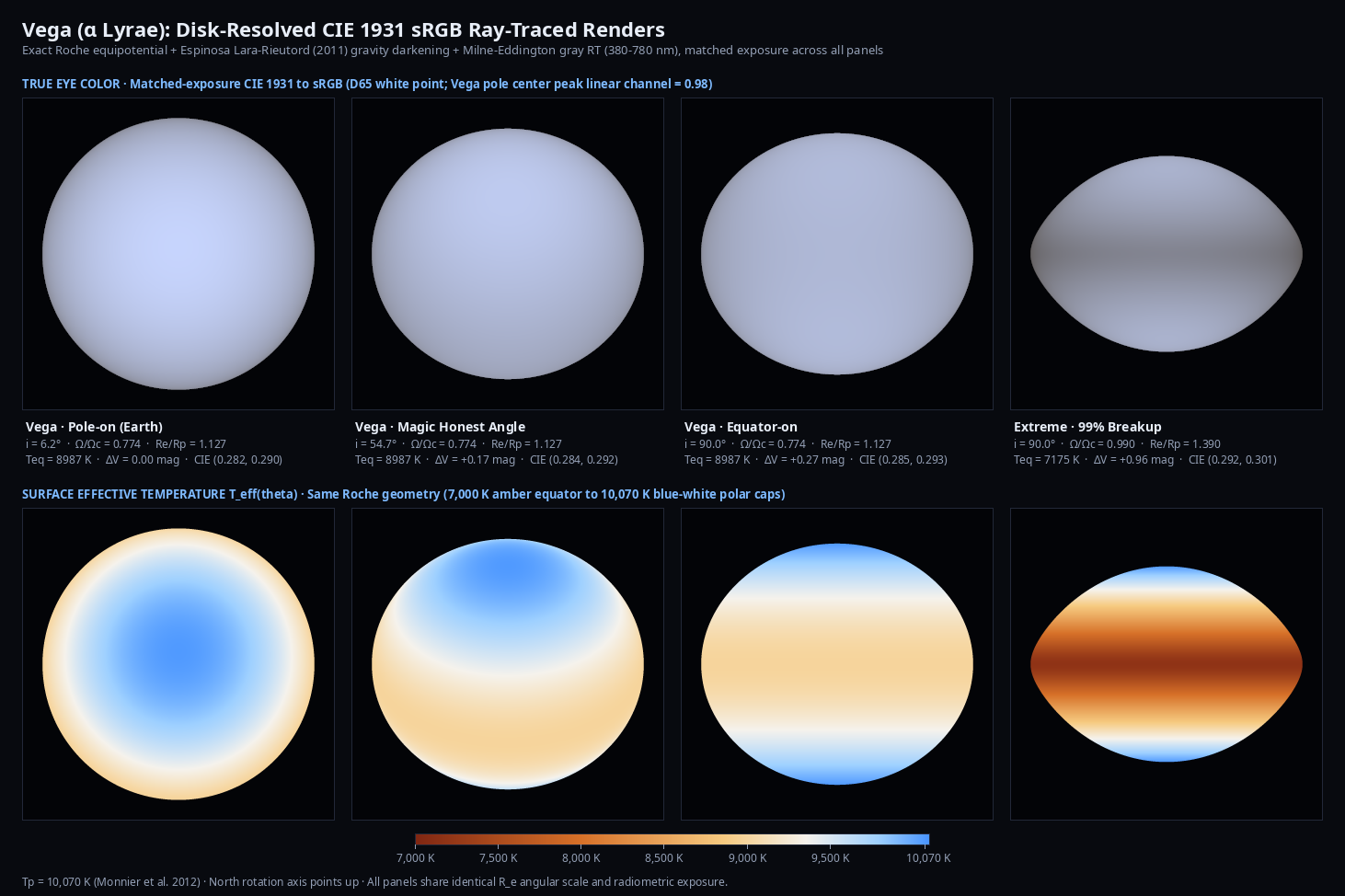
render_vega_disks.py ray-traces the exact implicit Roche surface $\Phi(x, y, z) = \Phi_0$ pixel-by-pixel with 4×4 limb supersampling, evaluates ELR (2011) $T_{\text{eff}}(\theta)$ and Milne–Eddington $I_\lambda(T_{\text{eff}}, \mu)$ across $380\text{–}780\text{ nm}$ through CIE 1931 2° color matching functions (Wyman–Sloan–Shirley 2013 fit), and converts XYZ to sRGB at matched exposure (anchored so pole-on Vega's peak linear channel is $0.98$).
The pixel-integrated $\Delta V$ values match Section 3's analytic ring integrals to three decimal places (+0.169 mag at $i = 54.74^\circ$, +0.267 mag at $i = 90^\circ$), and reveal a nice colorimetry point: across Vega's real $10{,}070\text{ K} \to 8{,}987\text{ K}$ gradient, true-eye chromaticity barely shifts (CIE $(0.282, 0.290) \to (0.285, 0.293)$ because the Planckian locus compresses above $8{,}500\text{ K}$), so human vision sees mostly the brightness gradient and oblateness (vega_disks.png, top row), while the calibrated $T_{\text{eff}}(\theta)$ thermal map (bottom row) makes the hot polar bullseye and warm equatorial collar jump straight out.
Limits & Honest Caveats #
- Gray vs. non-gray A0V atmosphere: Real $9{,}000\text{–}10{,}000\text{ K}$ A0V stars sit right at the peak of neutral hydrogen Balmer opacity (huge Balmer jump at $364.6\text{ nm}$). A gray atmosphere captures the continuous Wien/Rayleigh–Jeans limb-darkening slope cleanly (and hits Monnier's $L_{\text{app}} = 58.4\,L_\odot$ right on the nose), but real $U - B$ color shifts and exact UV limb darkening depend on bound–free H opacity (ATLAS9/Kurucz models).
- Roche point-mass + solid-body rotation: Real stars have non-zero core quadrupole moment $J_2$ and modest differential rotation (ESTER 2D models, Espinosa Lara & Rieutord 2013), though ELR (2011) showed the analytic $\omega$-model matches 2D ESTER profiles to a few percent across main-sequence A/B stars.
- Debris disk: Vega's famous IRAS debris disk dominates past $\lambda \gtrsim 12\,\mu\text{m}$; the $+0.54\%$ $K$-band effect above is purely photospheric.
Follow-up Threads Spawned #
- Add a simplified bound–free hydrogen ($H$ + $H^-$) non-gray opacity table to see how the Balmer jump amplifies $U - B$ vs. inclination across A0V–B5V stars.
- Run the exact same pipeline on Altair ($\alpha$ Aql, viewed nearly equator-on at $i \approx 57^\circ$!) and Achernar ($\alpha$ Eri, $R_e/R_p \approx 1.35\text{–}1.50$, near breakup) — does Altair sit right on our magic honest angle $i^* \approx 54.74^\circ$?! (Wait: Altair's inclination is $\sim 57^\circ$ — almost dead on the honest angle!!)