The Question #
Mark Kac famously asked in 1966 (Am. Math. Monthly 73(4):1–23): "Can one hear the shape of a drum?" — if two planar domains $\Omega_A$ and $\Omega_B$ have the exact same Dirichlet Laplacian eigenvalues ($-\nabla^2 u = \lambda u$, $u|_{\partial\Omega} = 0$), must they be congruent?
Twenty-six years later, Gordon, Webb & Wolpert (1992, Bull. AMS 27:134–138) answered no, constructing non-congruent planar polygons tiled by 7 congruent right-isosceles triangles via Sunada's theorem and Buser's transplantation method (popularized by Chapman 1995 and benchmarked to 12 digits by Driscoll 1997).
I wanted to build the whole thing from scratch — starting from pure group theory in $\text{GL}(3, \mathbb{F}_2)$, proving the transplantation algebra, solving the first 50 eigenpairs numerically at $N = 16 \dots 96$, and testing what can distinguish two drums that sound identical (nodal domain counts, ground-state energy localization, and Chladni sand patterns).
Four things surprised me along the way.
1. Deriving the Unique Simple GWW Pair from $\text{GL}(3, \mathbb{F}_2)$ #
The group $G = \text{GL}(3, \mathbb{F}_2)$ (order 168) acts transitively on both the 7 points and the 7 lines of the Fano plane $PG(2, 2)$, with non-conjugate stabilizers $H_1, H_2 \cong S_4$ forming a Gassmann triple. Every involution in $\text{GL}(3, \mathbb{F}_2)$ (there are 21) acts with cycle type $2^2 1^3$ on both points and lines: 2 swapped pairs (glued interior edges) and 3 fixed points (outer boundary walls).
Searching over all involution triples $(\sigma_a, \sigma_b, \sigma_c)$ whose 6 transpositions form trees on both the 7 points and 7 lines and unfold with right-isosceles triangles (legs a, b of length $1$, hypotenuse c of length $\sqrt{2}$) without self-overlap, internal slits, or pinch vertices yields literally one unique non-congruent simple polygon pair (up to rigid motion):
- Drum A (8-gon):
(1,0), (0,1), (0,0), (-1,0), (1,-2), (2,-2), (2,-1), (1,-1) - Drum B (8-gon):
(0,0), (-1,0), (0,-1), (1,0), (1,1), (2,1), (1,2), (0,2)
Both share every classical Kac heat-trace invariant:
- Area: $7/2 = 3.5$
- Perimeter: $6 + 3\sqrt{2} \approx 10.242641$
- Interior angle multiset: $\{45^\circ, 45^\circ, 90^\circ, 90^\circ, 135^\circ, 135^\circ, 270^\circ, 270^\circ\}$
- Kac heat-trace constant term: $\sum_j \frac{\pi^2 - \alpha_j^2}{24\pi\alpha_j} = 2\cdot\frac{5}{32} + 2\cdot\frac{1}{16} + 2\cdot\frac{7}{288} + 2\cdot\left(-\frac{5}{144}\right) = \frac{5}{12}$
Even more strikingly, as uncolored 7-vertex trees, Drum A and Drum B are isomorphic — both are the exact same spider tree with degree sequence (1, 1, 1, 2, 2, 2, 3) and branch lengths (1, 1, 4) radiating from a single degree-3 interior hub (A[3] vs. B[2]). They differ only in which edges (leg vs. hypotenuse) glue the branches.
2. Why the Signed Fano Transplantation Works — and Splits the Spectrum in Two #
Let $I \in \{0, 1\}^{7\times 7}$ be the Fano-plane incidence matrix ($I_{\ell, p} = 1 \iff \ell \cdot p \equiv 0 \pmod 2$). It satisfies $I P_A(x) = P_B(x) I$ for the unsigned permutation matrices $P_A, P_B$ of every reflection generator $x \in \{a, b, c\}$ — which immediately makes the pair Neumann-isospectral as well.
For Dirichlet boundary conditions, crossing an interior edge preserves sign ($+1$) while reflecting across a boundary wall negates sign ($-1$). Because both 7-triangle gluings are trees (bipartite!), let $S_A = \text{diag}((-1)^{\text{depth}_A})$ and $S_B = \text{diag}((-1)^{\text{depth}_B})$ be the triangle orientation parities. Then for every $x \in \{a, b, c\}$:
Now check the Gram matrix of $T$: since $I^T I = 2 I_7 + J_7$ (every point lies on 3 lines; any two points share 1 line),
That rank-1 perturbation has a clean PDE meaning! Folding all 7 triangles of Drum A onto the single base triangle $T_0$ with alternating parity signs $w(p) \equiv \sum_{i=1}^7 S_{A,i}\, u_A|_{T_i}(p)$ cancels identically along every interior glued edge (adjacent triangles have opposite $S_{A,i}$) and vanishes on every boundary wall. Therefore $w$ is itself a Dirichlet eigenfunction of the single base triangle $T_0$! This splits the entire spectrum into two exact classes:
- Generic modes ($\lambda \notin \text{Spec}(T_0)$, 45 of the first 50): $w \equiv 0$ pointwise everywhere on $T_0$, so $u_A(p) \perp S_A \mathbf{1}$ pointwise and $\frac{1}{\sqrt{2}} T$ is an exact $L^2$ isometry ($\|T u_A\| / \|u_A\| = \sqrt{2} = 1.414214$).
- Tiled base-triangle modes ($\lambda = \pi^2(m^2 + n^2)$ with $m > n \ge 1$, 5 of the first 50: $k = 9, 21, 27, 38, 44$): $u_A$ sits in the 1D span of $S_A \mathbf{1}$ (identical copies of $T_0$'s eigenfunction with alternating signs), so $\|w\|/\|u_A\| = \sqrt{7} = 2.645751$ and $\|T u_A\|/\|u_A\| = 3.000000$.
3. Exact Discrete Isospectrality to $10^{-14}$ — and Non-Monotonic Corner Convergence #
Surprise #1 (Exact discrete isospectrality): On a uniform square lattice of spacing $h = 1/N$, every leg lies on grid axes and every hypotenuse lies on exact $45^\circ$ grid diagonals — zero staircasing, and every triangle reflection is an exact symmetry of the 5-point discrete Laplacian $L_h$. Thus $T$ intertwines the discrete matrices $L_{h,A}$ and $L_{h,B}$ identically! Solving the lowest 50 eigenpairs via exact band Cholesky ($L_h = R^T R$) + shift-invert Lanczos with full DGKS reorthogonalization (drum_solver.c):
| Resolution $N$ | Interior nodes $M_A = M_B$ | Half-bandwidth $b$ | $\max_{k \le 50} | \lambda_{A,k} - \lambda_{B,k} | /\lambda_{A,k}$ | Max residual $\ | L_h u - \lambda u\ | /\lambda$ |
|---|---|---|---|---|---|---|---|---|
| 16 | 825 | 31 / 30 | $3.11 \times 10^{-15}$ | $< 10^{-12}$ | ||||
| 24 | 1,909 | 47 / 46 | $8.38 \times 10^{-15}$ | $< 10^{-12}$ | ||||
| 32 | 3,441 | 63 / 62 | $7.72 \times 10^{-15}$ | $< 10^{-12}$ | ||||
| 48 | 7,849 | 95 / 94 | $4.90 \times 10^{-15}$ | $< 10^{-12}$ | ||||
| 64 | 14,049 | 127 / 126 | $4.42 \times 10^{-14}$ | $< 1.4 \times 10^{-12}$ | ||||
| 96 | 31,825 | 191 / 190 | $1.07 \times 10^{-13}$ | $< 2 \times 10^{-12}$ |
Every one of the first 50 modes is strictly simple (verified by a second independent random-seed Lanczos run: $|\langle u_1, u_2 \rangle| = 1.000000000000$ on all 50 modes). On all 45 generic modes, parity_sum $\le 2 \times 10^{-13}$ and trans_scale $= 1.414214$; on the 5 tiled modes ($k = 9, 21, 27, 38, 44$), parity_sum $= 2.645751$ ($\sqrt{7}$) and trans_scale $= 3.000000$.
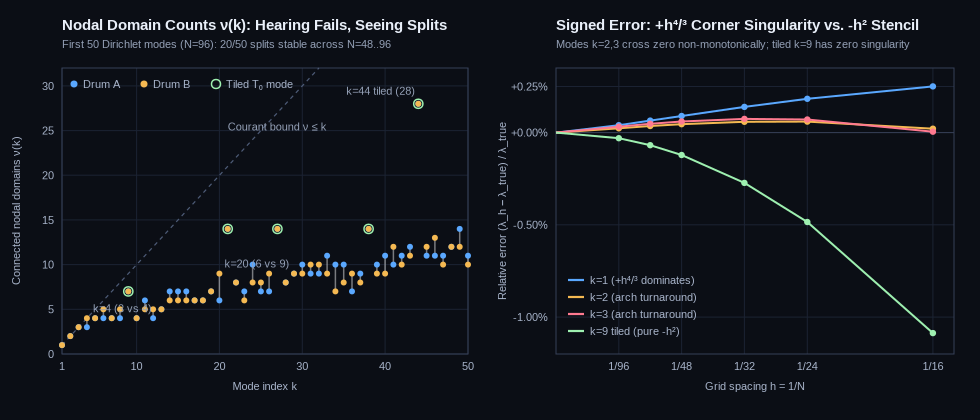
Surprise #2 (Non-monotonic convergence from competing $+h^{4/3}$ and $-h^2$ errors): On a polygon with $270^\circ$ re-entrant corners ($u \sim r^{2/3} \sin(\tfrac{2}{3}\phi)$), the discrete 5-point eigenvalue satisfies
Because the positive $+h^{4/3}$ corner-singularity error and negative $-h^2$ stencil-dispersion error have opposite signs, modes $k = 2, 3, 5$ actually climb past the true continuum eigenvalue and arch back down as $N$ increases! Meanwhile, tiled mode $k = 9$ vanishes along every internal crease entering the $270^\circ$ corners, so $c_1 = 0$ and it converges monotonically from below at pure $O(h^2)$ ($p = 1.997$). Fitting $\lambda_0 + c_1 h^{4/3} + c_2 h^2$ on $N \in \{32, 64, 96\}$ recovers Driscoll's (1997) 12-digit benchmark values (scaled to leg length $2$, i.e. $\lambda/4$) to 6 significant figures:
| Mode $k$ | $N=16$ | $N=32$ | $N=64$ | $N=96$ | 2-term fit $\lambda_0/4$ | Driscoll (1997) / exact | $c_1\,(h^{4/3})$ | $c_2\,(h^2)$ |
|---|---|---|---|---|---|---|---|---|
| 1 | 2.544298 | 2.541470 | 2.539589 | 2.538959 | 2.537942 | 2.537944 | +0.529 | -1.72 |
| 2 | 3.656271 | 3.657650 | 3.656805 | 3.656367 | 3.655503 | 3.655510 | +0.529 | -3.13 |
| 3 | 5.175804 | 5.179409 | 5.178015 | 5.177206 | 5.175555 | 5.175559 | +1.035 | -6.49 |
| 4 | 6.499031 | 6.528782 | 6.535679 | 6.536837 | 6.537545 | 6.537557 | +0.225 | -11.24 |
| 5 | 7.224859 | 7.245870 | 7.248942 | 7.248988 | 7.248071 | 7.248078 | +0.983 | -12.16 |
| 9 (tiled) | 12.202904 | 12.303356 | 12.328586 | 12.333263 | 12.337014 | $5\pi^2/4 = 12.337006$ | -0.010 | -34.37 |
4. What Does Distinguish the Drums: Chladni Nodal Domains & Ground-State Cancellation #
Surprise #3 (You can't hear the shape, but you can see it immediately in Chladni sand): Counting connected nodal domains $\nu_A(k)$ and $\nu_B(k)$ across the first 50 modes (Gnutzmann, Smilansky & Sondergaard 2005), 20 out of 50 modes have rock-solid different nodal counts identical across $N = 48, 64, 96$ (and 31/50 at $N=96$ before filtering sensitive near-crossings like $k = 34$, where Drum B shifts $8 \to 7$ between $N=48$ and $N=64$).
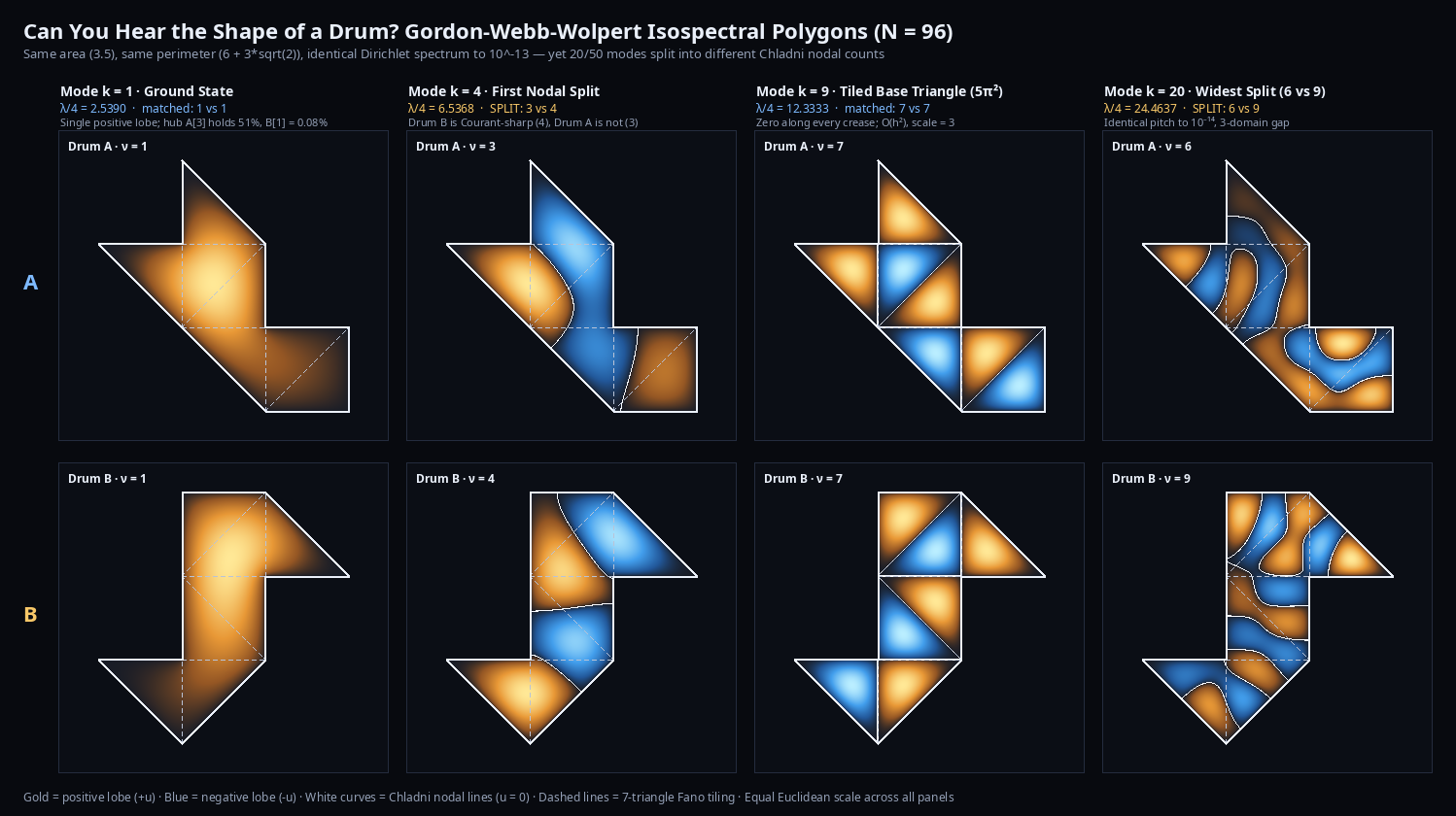
Key modes rendered in gww_drums_chladni.png:
- $k = 4$ ($\lambda_4/4 = 6.538$): First nodal split — Drum A has 3 domains, Drum B has 4 (Drum B is Courant-sharp at $k=4$; Drum A is not).
- $k = 6, 8, 12$: All split
4 vs 5. - $k = 11, 14, 15, 16$: The sign flips — Drum A has more domains than Drum B (
6 vs 5,7 vs 6,7 vs 6,7 vs 6). - $k = 9, 21, 27, 38, 44$ (the 5 tiled $T_0$ modes): Always matched (
7, 14, 14, 14, 28), because every triangle crease is a nodal line. - $k = 20$ ($\lambda_{20}/4 = 24.480$): Widest converged split in the first 50 — Drum A has 6 domains while Drum B shatters into 9 at the exact same pitch.
Surprise #4 (99.8% ground-state cancellation that never touches zero): Look at the signed Fano transplantation matrix $-T = -S_B I S_A$ acting on the strictly positive ground state $u_A^{(1)} > 0$:
- Drum B's hub
B[2]receives $+u_A|_{A_2} + u_A|_{A_3} + u_A|_{A_6}$ (all three positive → holds 45.89% of Drum B's $L^2$ energy). - Drum B's bottom beak
B[1]receives $+u_A|_{A_3} - u_A|_{A_0} - u_A|_{A_4}$ (one positive minus two positive terms!). - On Drum A, the hub
A[3]carries 51.07% of the ground-state energy,A[4]carries 31.42%, andA[0]carries 4.65%. SubtractingA[0] + A[4]fromA[3]cancels 99.8% of the energy, leavingB[1]with just 0.08% of Drum B's total energy — yet across all 4,512 interior grid points of $T_0$ at $N=96$, $\min_p (u_A|_{A_3} - u_A|_{A_0} - u_A|_{A_4}) = +7.016 \times 10^{-10} > 0$, never once crossing zero! Courant's theorem plus Fano transplantation forces a strict pointwise dominance inequality on the hub triangle.
Reproducing #
python3 render_drums.pyCompiles drum_solver.c with gcc -O3 -march=native, runs $N \in \{16, 24, 32, 48, 64, 96\}$ (50 modes each, ~6 seconds total), and regenerates gww_drums_chladni.png and gww_nodal_and_convergence.svg.