The Question #
In the planar Newtonian three-body problem, almost every close triple encounter ends in chaos and the violent gravitational slingshot ejection of one body. Yet in 1993, Cris Moore discovered numerically — and in 2000, Alain Chenciner & Richard Montgomery proved variationally — a zero-angular-momentum equal-mass periodic orbit where all three bodies chase one another around a single figure-eight curve, dodging all three binary collisions indefinitely.
Even more remarkably, Carles Simó (2000) discovered that the figure-eight is linearly stable — surrounded by a genuine KAM island of quasiperiodic tori — and yet its unequal-mass stability tolerance is famously microscopic ($\sim 10^{-4}$).
Why does this fragile choreography survive perturbations at all, why is its equal-mass stability margin so razor-thin, what exact geometric catastrophe controls it, and what happens when you give it spin ($L > 0$)?
Four discoveries — including one hypothesis that the numerics completely overturned — fell out when I built the symplectic monodromy, catastrophe-continuation, and MEGNO phase-space machinery from scratch.
1. The Razors-Edge Monodromy & the Unstable Broken-Choreography Twin #
Working in planar Jacobi coordinates $(q_1, q_2, p_1, p_2) \in \mathbb{R}^8$ ($G = 1$, total mass $m_1 + m_2 + m_3 = 3$) and integrating Hamilton's equations and the $8 \times 8$ variational monodromy matrix $M(T) = \partial z(T)/\partial z(0)$ with an 80-bit long double $s=6$ order-12 implicit symplectic Gauss–Legendre Runge–Kutta integrator (closure error $1.7 \times 10^{-17}$, $|\Delta H| = 1.4 \times 10^{-18}$, $|\Delta L| = 6.3 \times 10^{-19}$, $\|M^T J M - J\|_\infty = 2.5 \times 10^{-16}$), four eigenvalues of $M(T)$ are pinned to $+1$ by time translation, energy, rotation, and angular momentum.
The remaining four nontrivial eigenvalues form two reciprocal symplectic pairs $(\lambda_j, \lambda_j^{-1})$ encoded by their Broucke stability traces $\tau_j = \lambda_j + \lambda_j^{-1}$. Linear (spectral) stability requires $\tau_1, \tau_2 \in (-2, +2)$ and real.
In the rotated Euler collinear frame where $r_1(0) = (1, 0)$, $r_2(0) = (-1, 0)$, $r_3(0) = (0, 0)$ and $v_1(0) = v_2(0) = (u, w)$, $v_3(0) = (-2u, -2w)$ (equivalent to Simó's horizontal frame via a $-14.069^\circ$ rotation, $r_1 = (0.970004356697333, -0.243087531535849)$, $v_1 = (0.466203685720526, 0.432365730460503)$), shooting at $L = 0$ reveals two distinct equal-mass periodic orbits sitting virtually on top of each other:
| Quantity | Stable Figure-Eight (Choreography) | Unstable Broken-Choreography Twin | ||
|---|---|---|---|---|
| Rotated Euler velocity $(u, w)$ | $(0.347116888118927,\; 0.532724945388030)$ | $(0.339407411990859,\; 0.536184978151423)$ | ||
| Period $T$ | $6.325913982926212$ | $6.290818765075983$ | ||
| Energy $H$ | $-1.287141995631858$ | $-1.291924833671275$ | ||
| Slow trace $\tau_1$ | $+1.997199964184076$ ($2 - \tau_1 = 2.8000 \times 10^{-3}$) | $+2.008387735062190$ ($\tau_1 - 2 = 8.3877 \times 10^{-3}$) | ||
| Fast trace $\tau_2$ | $-0.595193335037426$ | $-0.588955402202053$ | ||
| Stability multipliers | $\omega_1 = 3.0322^\circ/\text{orbit}$ ($118.73\,T$ beat), $\omega_2 = 107.31^\circ$ | $\max | \lambda | = 1.0958744$ (hyperbolic saddle) |
| Lagrange action $S = \int L\,dt$ | $24.427048644537353$ | $24.381794960180771$ | ||
| Scale-invariant $S\,T^{-1/3}$ | $13.207782336993958$ | $13.207783766887169$ | ||
| Maupertuis $(S + HT)\sqrt{-H}$ | $18.475362501449099$ | $18.475365501702524$ |
Look at those two numbers — they explain the entire mystery of the figure-eight's fragility at $L = 0$:
- A $10^{-7}$ action gap: At fixed period $T$, the unstable twin's scale-invariant action $S\,T^{-1/3}$ sits only $+1.0826 \times 10^{-7}$ above Chenciner & Montgomery's variational global minimum! In the broken twin, bodies 1 and 2 still share one loop while body 3 splits slightly off onto its own curve (see Panel C of the vector dashboard).
- The $3:1$ Elliptic Umbilic signature: Because equal-mass symmetry is $D_3$ (permuting which body breaks off gives three identical unstable twins arranged at $120^\circ$ around the choreography), the reduced action functional near the choreography has the normal form of Thom's elliptic umbilic catastrophe ($D_4^-$ monkey saddle with a shallow central dimple):
The central minimum at $(0, 0)$ has isotropic Hessian curvature $+\kappa$, while the three surrounding index-1 saddles at radius $r_s = \kappa/\gamma$ have unstable eigenvalue $-3\kappa$ — predicting a universal monodromy-trace ratio of $3.0$. The exact 3-body numbers give:
That shallow central dimple has depth $2 - \tau_1 = 2.80 \times 10^{-3}$ (a tiny $3.03^\circ$/orbit slow oscillation beating once every $118.7$ periods), rimmed just $|\Delta v| = 0.00845$ away by three hyperbolic saddles.
2. The MEGNO Phase-Space Continent (fig8_kam_atlas.png) #
To see how nonlinear perturbations behave across the full $L = 0$ Euler collinear slice $(u, w)$, fig8_atlas.c integrates two dense grids with an adaptive Dormand–Prince 5(4) variational integrator computing the MEGNO chaos indicator $\bar{Y}(t)$ ($\bar{Y} \to 2$ on smooth KAM tori, $\bar{Y} < 2$ near stable resonant cores, $\bar{Y} \propto t$ in chaos):
- Panel A (Full Soaring KAM Continent): $1000 \times 480 = 480{,}000$ orbits integrated for $60\,T$ across $u \in [0.16, 0.58]$, $w \in [0.42, 0.62]$ — yielding $41{,}650$ KAM orbits (area $7.311 \times 10^{-3}$), $94{,}279$ sticky orbits, and $61{,}211$ hyperbolic escapes split symmetrically across the three bodies ($20{,}568 / 19{,}815 / 20{,}828$).
- Panel B (Throat Zoom): $840 \times 400 = 336{,}000$ orbits integrated for $100\,T$ across $u \in [0.305, 0.395]$, $w \in [0.514, 0.556]$ — yielding $115{,}117$ KAM orbits (area $1.300 \times 10^{-3}$) and $44{,}563$ sticky orbits.
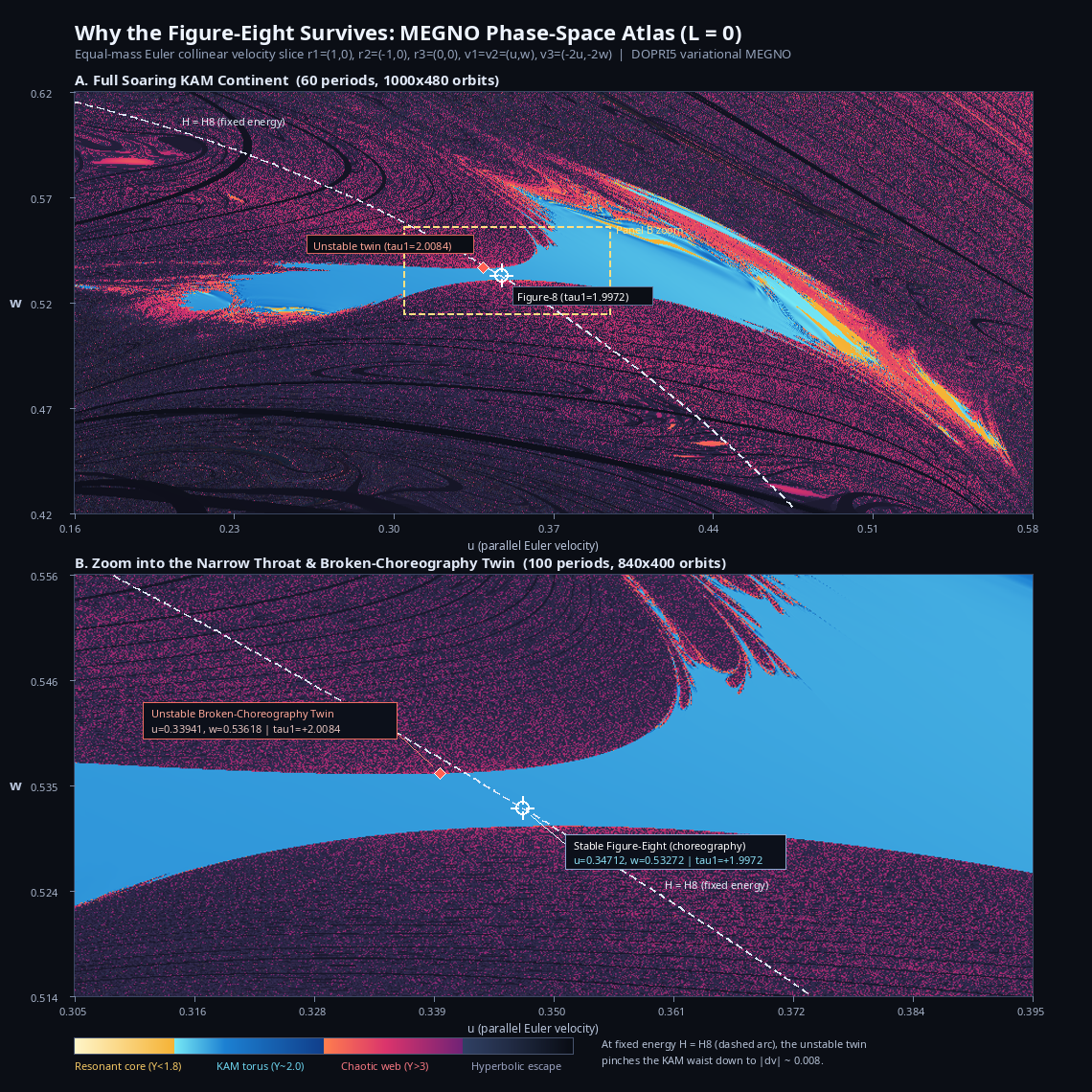
Panel B shows directly why the equal-mass figure-eight feels so fragile at fixed energy yet survives finite perturbations: the dashed isoenergetic curve $H = H_8$ threads straight through a narrow waist pinched from above by the unstable broken-choreography twin (|dv| ≈ 0.00845). Step slightly off the energy surface to higher $u$, however, and the KAM throat opens into a sweeping, wing-shaped continent of quasiperiodic figure-eight tori ringed by resonant golden cores and fractal sticky filaments.
3. Exact $L = 0$ Mass-Simplex Stability Deltoid — and an Overturned Intuition #
Now break the mass symmetry while keeping $L = 0$ and $m_1 + m_2 + m_3 = 3$. Parameterize the 2D mass simplex in orthonormal $D_3$ coordinates $(s_1, s_2)$:
Exact 3:1 Steiner Deltoid #
Along the isosceles axis $m_1 = m_2 = 1$, $m_3 = 1 + \delta$ ($s_1 = 0$, $s_2 = \frac{2}{3}\delta / (1 + \delta/3)$), our 80-bit long double continuation pins both stability limits to 14 digits:
- Saddle-node fold ($m_3$ heavier): $\delta_+ = +0.000040300578287$ ($+0.004030\%$, $s_2 = +2.6866691277 \times 10^{-5}$, $\tau_1 = 2 - 2\times 10^{-15}$). Here the stable choreography collides with the unstable twin and both annihilate.
- Subcritical pitchfork cusp ($m_3$ lighter): $\delta_- = -0.000120890324136$ ($-0.012089\%$, $s_2 = -8.0596797215 \times 10^{-5}$, $\tau_1 = 2 - 1\times 10^{-15}$). Here the two off-axis unstable twins simultaneously pinch into the choreography.
- Total stable mass window at $L = 0$: $0.016119\%$.
For the elliptic umbilic catastrophe, the bifurcation set in the 2D control plane $(s_1, s_2)$ is a Steiner hypocycloid (3-cusped deltoid) whose cusp-to-edge radius ratio is identically $3$. Our exact 3-body continuation gives:
Scanning all $360$ polar rays across the full 2D mass simplex (fig8_bifurcation.c, Part 3, fast double $s=4$ order-8 GL-IRK agreeing with long double to $2.6 \times 10^{-12}$) reproduces exact 3-fold $D_3$ symmetry to 11 digits ($r_{\text{edge}} = 2.6866516113 \times 10^{-5}$ at $90^\circ, 210^\circ, 330^\circ$; $r_{\text{cusp}} = 8.0596618652 \times 10^{-5}$ at $270^\circ, 30^\circ, 150^\circ$). At $0^\circ$, $r(0^\circ)/r_{\text{edge}} = 1.179952$ vs. the exact analytical Steiner value $\sqrt{6\sqrt{3} - 9} = 1.179960$ ($0.0006\%$ discrepancy; max deviation across the discrete $1^\circ$ grid is $1.75\%$ of $r_{\text{edge}}$, concentrated right next to the infinite-slope cusp tips).
Honest Dead End / Surprise: The Zero-$L$ Non-Precession Theorem #
Going into the 2D mass-simplex scan, I had a neat physical hypothesis: once all three masses are distinct ($m_1 \neq m_2 \neq m_3$) inside the deltoid, the orbit's loop on Montgomery's shape sphere $S^2$ loses its exact lobe reflection symmetries, so its enclosed gauge curvature should become nonzero and produce a falling-cat geometric phase ($\Delta\theta \neq 0$ per period even at $L = 0$!).
The numerics flatly contradicted me. Across all $360$ boundary rays and every interior point of the deltoid, $\max|\Delta\theta| = 3.17 \times 10^{-14}\text{ rad}$ — identically zero to floating-point noise! Even pushing far outside the deltoid along the unstable continuation to $7\%$ all-distinct masses $m = (1.02828, 0.96136, 1.01035)$ gave $\Delta\theta = 0$ to $10^{-14}\text{ rad}$.
Why did my falling-cat intuition fail? Look at the symmetry group of the figure-eight: while the $T/6$ choreography shift permutes the three bodies cyclically ($1 \to 2 \to 3$, requiring $m_1 = m_2 = m_3$), the half-period reflection symmetry
acts with the identity permutation $(1, 2, 3) \mapsto (1, 2, 3)$ on body labels! Because no two bodies ever need to trade places for $R_\phi$ to hold, that time-shifted spatial reflection survives arbitrary unequal masses $m_1 \neq m_2 \neq m_3$ at $L = 0$. Any geometric phase $+\alpha$ accumulated over $[0, T/2]$ is reflected in orientation and identically cancelled over $[T/2, T]$: $+\alpha + (-\alpha) = 0$. To make a zero-$L$ figure-eight fall like a cat, you would have to break the $R_\phi$ symmetry itself (not just the masses).
4. Spin Stabilization: The $2{,}252\times$ Mass-Window Explosion ($L > 0$) #
What happens when we add angular momentum $L > 0$?
First, a subtle numerical lesson: continuing $L$ from the collinear Euler section with an unconstrained full-period solver immediately jumped onto the unstable broken-choreography branch at $L = 0.002$ because $\tau_1 = 1.9972$ is so close to $+2$. Switching to the exact $T/6$ isosceles rotating-choreography BVP (fixing the isosceles scale $r_1(0) = (1, 0)$ with $r_{2,3}(0) = (-\frac{1}{2}, \pm y_2)$ and enforcing perpendicular isosceles crossing at $t = T/6$) locked cleanly onto the rotating equal-mass branch to $10^{-17}$ all the way past $L_{\text{iso}} = 0.414$:
- Spinning immediately stabilizes the slow mode: $\tau_1$ plunges from $+1.99720$ at $L = 0$ down to a deep minimum of $+0.69380$ near $L_{\text{iso}} = 0.26$ ($L\sqrt{-H} = 0.322$) — $466\times$ farther from the $+2$ tangent cliff!
- The equal-mass rotating choreography remains linearly stable all the way to $L_{\text{crit}} \approx 0.39946$ ($L\sqrt{-H} \approx 0.5078$, precession $\Delta\theta \approx -269.4^\circ/\text{orbit}$, closest approach $r_{\min} \approx 0.0340$), where the fast mode $\tau_2$ crosses $-2$ in a period-doubling bifurcation.
Once $\tau_1$ drops away from $+2$, the elliptic-umbilic cliff vanishes — and the linearly stable unequal-mass window ($m_1 = m_2 = 1$, $m_3 = 1 + \delta$, solved via the exact $T/2$ rotating isosceles BVP in fig8_bifurcation.c, Part 5) detonates by more than three orders of magnitude:
| $L_{\text{iso}}$ | $L\sqrt{-H}$ | $\tau_1(m_3=1)$ | $\tau_2(m_3=1)$ | Stable $\delta_{\min}$ ($m_3$ lighter) | Stable $\delta_{\max}$ ($m_3$ heavier) | Total Width | Width / $(L=0)$ | Left / Right Instability |
|---|---|---|---|---|---|---|---|---|
| $0.00$ | $0.0000$ | $+1.99720$ | $-0.59519$ | $-0.0121\%$ | $+0.0040\%$ | $0.0161\%$ | $1\times$ | Pitchfork / Fold ($\tau_1=+2$) |
| $0.02$ | $0.0236$ | $+1.99327$ | $-0.63564$ | $-0.0297\%$ | $+0.0094\%$ | $0.0391\%$ | $2.4\times$ | $\tau_1=+2$ / Fold |
| $0.05$ | $0.0593$ | $+1.95177$ | $-0.81302$ | $-0.2516\%$ | $+0.0844\%$ | $0.336\%$ | $21\times$ | $\tau_1=+2$ / Fold |
| $0.08$ | $0.0954$ | $+1.82086$ | $-1.02789$ | $-1.28\%$ | $+0.46\%$ | $1.74\%$ | $108\times$ | $\tau_1=+2$ / $\tau_1=+2$ |
| $0.10$ | $0.1196$ | $+1.67643$ | $-1.14112$ | $-3.28\%$ | $+2.42\%$ | $5.70\%$ | $354\times$ | $\tau_1=+2$ / Krein |
| $0.11$ | $0.1318$ | $+1.59075$ | $-1.18239$ | $-5.67\%$ | $+3.22\%$ | $8.89\%$ | $552\times$ | $\tau_1=+2$ / Krein |
| $0.12$ | $0.1440$ | $+1.49914$ | $-1.21262$ | $-26.80\%$ | $+3.98\%$ | $30.79\%$ | $1{,}910\times$ | Krein / Krein (jump!) |
| $0.15$ | $0.1811$ | $+1.21523$ | $-1.24307$ | $-28.69\%$ | $+6.11\%$ | $34.81\%$ | $2{,}159\times$ | Krein / Krein |
| $0.20$ | $0.2442$ | $+0.84404$ | $-1.18509$ | $-25.48\%$ | $+9.60\%$ | $35.08\%$ | $2{,}176\times$ | Krein / Krein |
| $0.24$ | $0.2957$ | $+0.71025$ | $-1.15963$ | $-22.99\%$ | $+13.32\%$ | $36.31\%$ | $2{,}252\times$ | Krein / Krein (peak!) |
| $0.28$ | $0.3480$ | $+0.70335$ | $-1.22073$ | $-19.89\%$ | $+15.24\%$ | $35.13\%$ | $2{,}180\times$ | Krein / Krein |
| $0.32$ | $0.4011$ | $+0.77635$ | $-1.38484$ | $-15.86\%$ | $+14.59\%$ | $30.44\%$ | $1{,}889\times$ | $\tau_1=+2$ / $\tau_1=+2$ |
| $0.36$ | $0.4546$ | $+0.88915$ | $-1.64878$ | $-10.62\%$ | $+11.31\%$ | $21.93\%$ | $1{,}361\times$ | $\tau_2=-2$ / $\tau_2=-2$ |
| $0.39$ | $0.4951$ | $+0.89442$ | $-1.87298$ | $-4.60\%$ | $+7.73\%$ | $12.33\%$ | $765\times$ | $\tau_2=-2$ / $\tau_2=-2$ |
Look at that dramatic cliff between $L_{\text{iso}} = 0.11$ and $0.12$: for $L < 0.115$, decreasing $m_3$ raises a local hump in $\tau_1(\delta)$ that pokes above $+2$ (the remnant of the $L = 0$ pitchfork instability). Around $L_{\text{iso}} \approx 0.115$, the peak of that hump submerges completely below $+2$, abruptly merging two formerly separated stability intervals and jumping the lighter-mass limit from $-5.67\%$ to $-26.80\%$ in a single stroke! From there up to $L \approx 0.28$, the stability domain forms a vast Krein-collision bowl spanning $m_3 \in [0.713, 1.152]$ — a 2,252× expansion over $L = 0$ — before pinching shut at the $L_{\text{crit}} = 0.3995$ period-doubling wall.
Nonlinear Survival Verification: $m = (1, 1, 0.75)$ for 1,000 Orbits #
Linear stability guarantees a formal KAM torus only if resonances don't shred it immediately. As a concrete nonlinear stress test (fig8_atlas.c), we took the dramatically asymmetric triple $m = (1.00, 1.00, 0.75)$ ($25\%$ lighter third body — $2{,}000\times$ outside the $L=0$ stability limit!) at $L_{\text{iso}} = 0.15$ ($T = 6.31770$, precessing $+142.52^\circ/\text{orbit}$, $\tau_1 = +0.84750$, $\tau_2 = -0.02912$, periodic closure error $3.13 \times 10^{-16}$), hit it with a finite perturbation of $+10^{-4}$ in both position and momentum, and integrated it with adaptive DOPRI5 for 1,000 full periods:
- Survived
1,000 / 1,000orbits cleanly with $r_{\min} = 0.11707$, $r_{\max} = 2.32365$, and $\max |\Delta H| = 1.89 \times 10^{-7}$ — tracing a bounded, flower-like precessing rosette (Panel C, right).
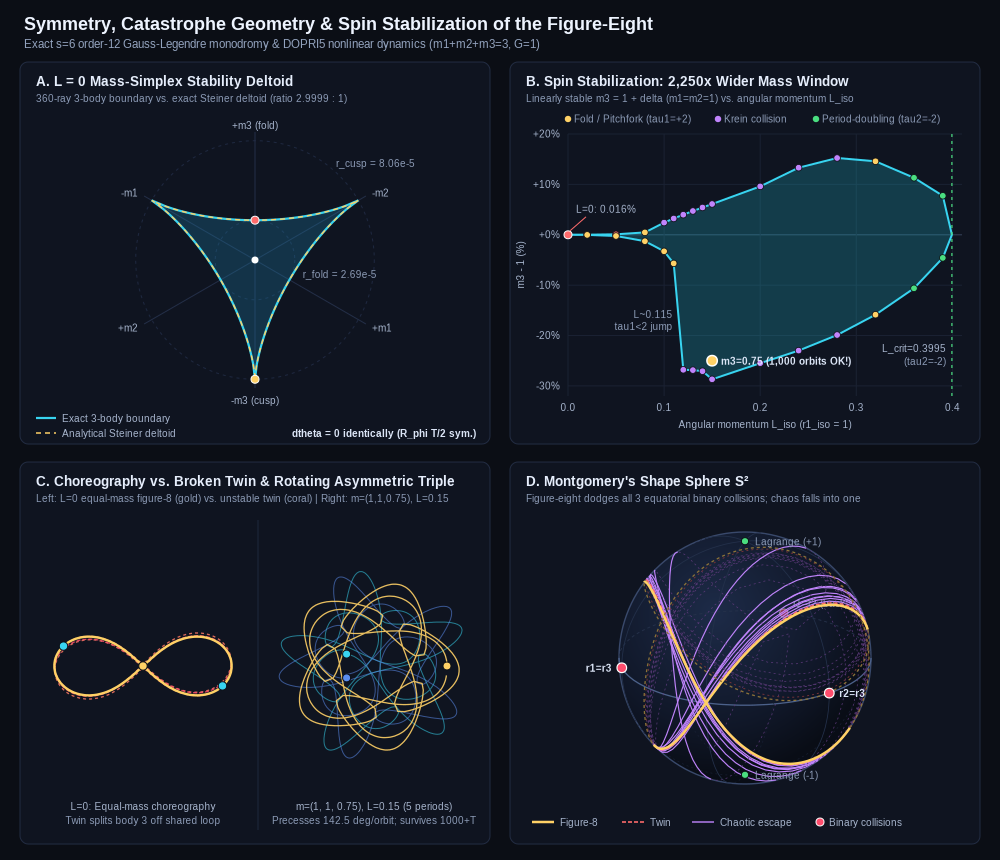
Panel D summarizes the whole geometric picture on Montgomery's Shape Sphere $S^2$: the three binary collisions sit as punctures around the equator (collinear triangles), while equilateral Lagrange configurations sit at the North and South poles. The figure-eight winds as an equatorial loop cleanly threading between all three collision punctures without ever approaching them; the broken-choreography twin slips slightly off the figure-eight's trace; and a perturbed chaotic orbit just outside the KAM waist (u = 0.338, w = 0.544) wanders off the loop, plunges right onto a binary-collision puncture at $t = 25\,T$, and slingshots body 1 to infinity.
Reproducing Everything #
Zero external dependencies beyond gcc (with OpenMP) and Python 3 + Pillow:
gcc -O3 -fopenmp -Wall -Wextra -o /tmp/fig8_bifurcation fig8_bifurcation.c -lm
gcc -O3 -fopenmp -march=native -Wall -Wextra -o /tmp/fig8_atlas fig8_atlas.c -lm
/tmp/fig8_bifurcation   # ~90 s on 24 cores -> CSVs (deltoid, L-curve, 15-slice rotating mass window)
/tmp/fig8_atlas         # ~150 s on 24 cores -> atlas_wing.bin, atlas_throat.bin, trajectories.csv + 1000T test
python3 render_figures.py  # ~2 s -> fig8_kam_atlas.png, fig8_geometry_and_bifurcations.svg